

Artificial Intelligence (AI) has been making headlines across industries, but for small businesses it’s not just a buzzword — it’s a practical tool that can simplify tasks, boost productivity, and help you better connect with customers. In this post, we’ll explore what AI is, the different types of AI, what it’s doing well today, how small businesses can put it to work — without fear of being replaced — and how real‑world numbers show it works.
1. What is AI?
At its core, Artificial Intelligence refers to computer systems designed to perform tasks that normally require human intelligence. This can include recognizing patterns, understanding natural language, making decisions, or even predicting outcomes. Unlike traditional software that follows explicit rules, AI systems can learn from data and improve over time, giving small businesses powerful ways to work smarter, not harder. Gusto
Example for small businesses: A local café uses an AI‑powered scheduling tool that analyses customer foot‑traffic over the week and predicts peak and slow times — enabling the manager to schedule staff more effectively, reduce over‑staffing on slow days, and ensure coverage on busy days without manual spreadsheets.
2. What different types of AI are there?
AI comes in many forms, each suited for different tasks:
- Reactive AI: These systems react to specific inputs but don’t retain memory.
- Machine Learning (ML): ML algorithms learn patterns from data and make predictions.
- Natural Language Processing (NLP): This allows machines to understand and generate human language — chatbots, automated writing assistants, etc.
- Generative AI: Systems that can create new content (images, text, music) based on existing data.
- Expert Systems: AI designed to mimic human decision‑making in specialized areas, such as diagnosing issues or recommending actions.
- Robotics: Physical AI systems that automate manual or repetitive tasks (such as warehousing, manufacturing).
- Agentic AI (Intelligent Agents): More advanced AI that can perform tasks autonomously over time, learning from feedback and taking actions.
Another useful classification: AI by capability (e.g., Narrow AI vs General AI) or by functionality (e.g., perception, cognition, decision‑making). business.com
Example for small businesses: A boutique e‑commerce shop uses a generative AI tool to produce product description text (Generative AI + NLP). Meanwhile, their accounting software uses ML to flag unusual expenses automatically (Machine Learning). And a small manufacturing firm uses a robotics arm (Robotics) for one repetitive assembly step, freeing up a worker for higher‑value tasks.
3. What is AI doing well today
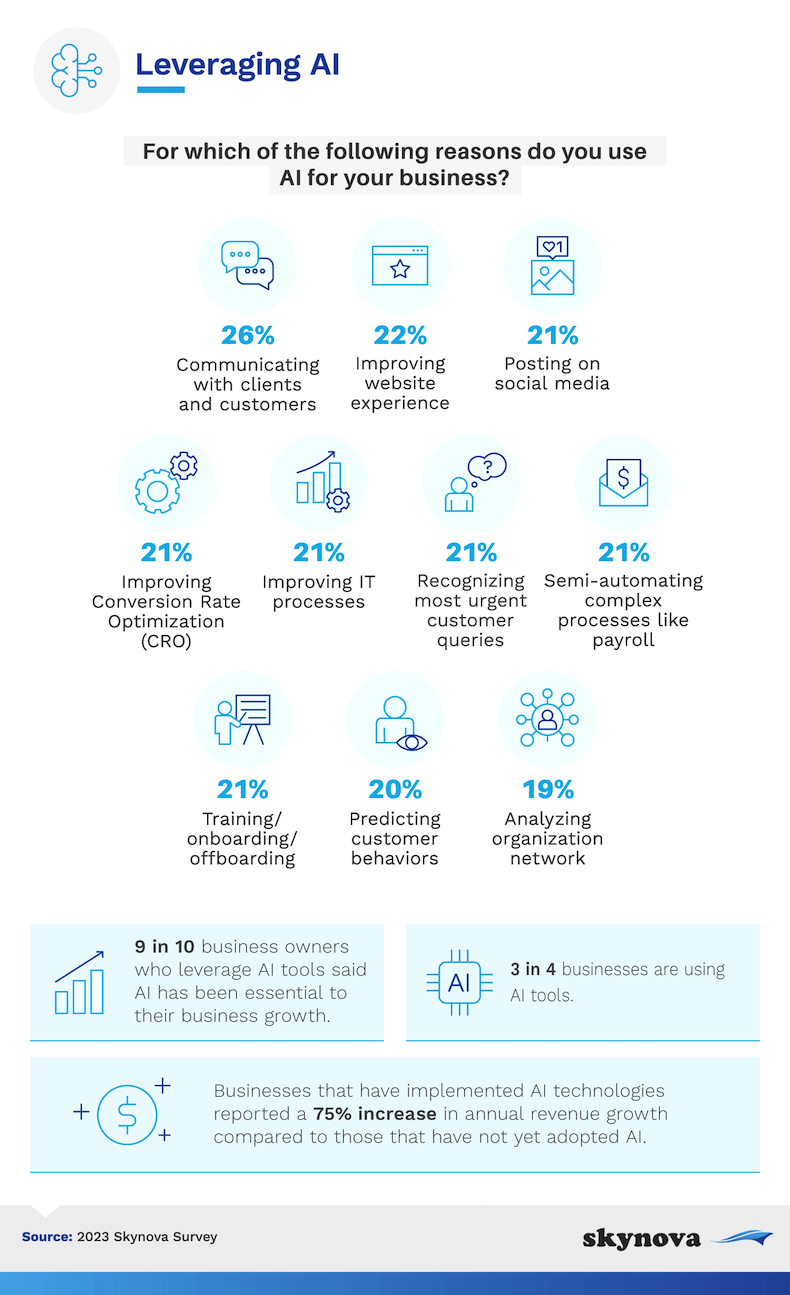
AI excels at repetitive, time‑consuming, and data‑heavy tasks. Examples include:
- Automating customer support through chatbots.
- Analyzing data to find trends and insights.
- Generating content like social media posts or product descriptions.
- Predicting sales or inventory needs.
- Personalizing marketing campaigns based on customer behavior.
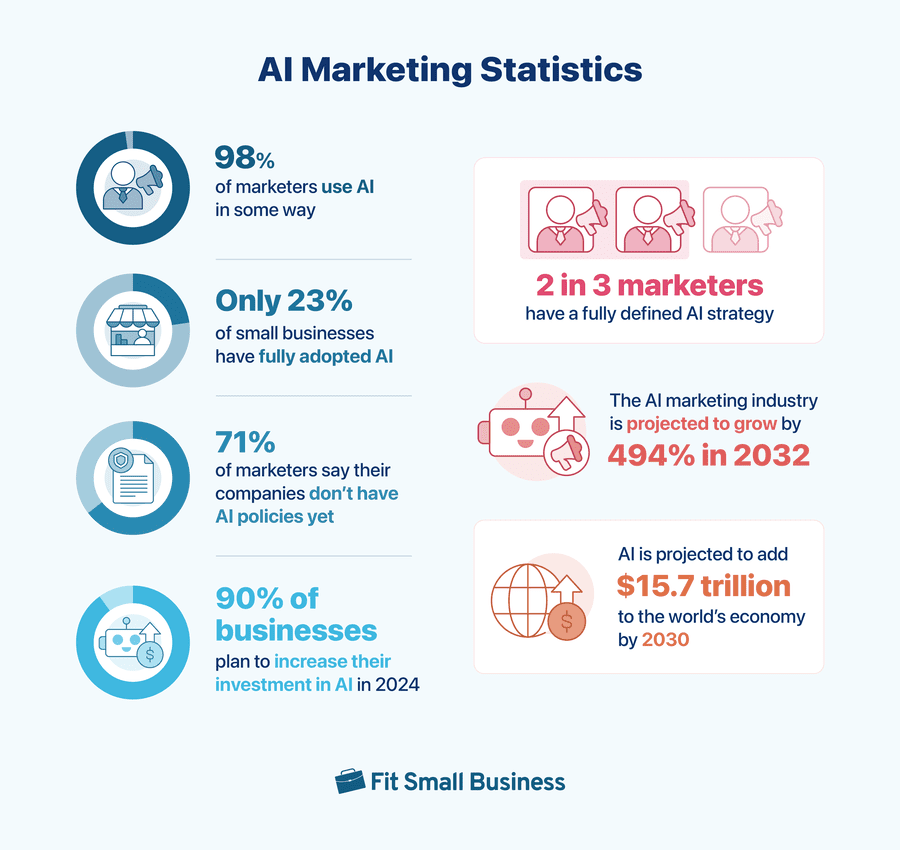
Here are some compelling statistics illustrating how AI is already impacting small businesses:
- 77% of small businesses that use AI reported increased efficiency. ZipDo
- More than 40% of small business owners say GenAI users saw revenue grow by 20% or more. Gusto
- 91% of SMEs using AI report revenue boosts, and 87% say it helps them scale operations faster than manual competitors. Sme Scale
- Small business owners report savings of approximately $273.5 billion annually from time and cost savings enabled by AI tools. SBE Council
Example for small businesses: A local digital marketing agency uses an AI‑powered analytics dashboard that tracks both organic and paid channels; it automatically suggests which social posts are under‑performing and should be tweaked. This frees the agency owner from hours of spreadsheet work and lets them focus on strategy and client relationships.
4. AI as a Tool in the Toolbox
It’s important to remember: AI is a tool, not a replacement for humans. While it can automate certain tasks, it works best when combined with human judgment and expertise. Think of AI as a helper that handles the repetitive or time‑consuming parts of your work, leaving you free to focus on creativity, problem‑solving, and customer engagement. business.com
Example for small businesses: A small law‑firm employs an AI document‑review tool that identifies standard clauses and flags unusual ones. The lawyer still reviews and makes the final call — but the time spent on basic reviews is reduced from hours to minutes. The lawyer then uses that saved time to focus on strategy, client counseling, or more complex issues — not replaced, but freed for higher‑value work.
5. How AI Can Help Web Development
Small businesses can leverage AI in web development in several ways:
- Website builders & templates: AI‑powered platforms that generate layouts, templates, and content suggestions (making launching a website faster).
- User experience improvements: AI can analyze visitor behaviour (clicks, scrolls, bounce‑rates) to optimize navigation and design.
- SEO optimisation: AI tools can suggest keywords, meta descriptions, content improvements to improve search rankings.
- Automated testing & maintenance: AI can identify broken links, page errors, or design inconsistencies before they impact users.
Example for small businesses: A local real‑estate agent uses an AI website builder to launch their landing page. The platform uses a generative model to propose header text, image suggestions and layout. Then an analytics‑plugin uses ML to track which pages are getting clicks and suggests moving the “Contact Us” button to a more prominent location. The agent didn’t need extensive web‑dev skills or hire a full developer — AI accelerated and simplified the process.
6. How AI Can Help Social Media Marketing
Social media is another area where AI shines for small businesses:
- Content generation: AI can create captions, posts, or even image suggestions (via generative models).
- Scheduling & posting: AI tools determine the best times to post for maximum engagement based on historical data.
- Analytics & insights: AI can track engagement, follower growth, sentiment, trending topics — helping you make data‑driven decisions.
- Ad targeting & optimization: AI analyses user behavior to better target ads to the right audience, improving ROI.
Example for small businesses: A local bakery uses an AI‑driven social‑media assistant. It generates suggestions for daily posts (e.g., new flavor announcements, behind‑the‑scenes images), recommends optimal posting times for Instagram and Facebook, and provides weekly reports on which posts got the most engagement (and why). The bakery owner spends less time figuring out when/what to post and more time baking and interacting with customers in person.
7. Sum Up: AI Doesn’t Replace the Need for People
AI isn’t here to take over small businesses — it’s here to help them grow. From web development to social media marketing, AI can handle the repetitive, time‑consuming parts of your tasks, freeing you to focus on what matters most: your customers and your business vision.
With humans still at the centre — making the strategic decisions, bringing creativity, empathy, and domain knowledge — AI becomes a powerful tool in your toolbox that enables you to operate more efficiently, make smarter decisions, and deliver better experiences to your customers.
Example for small businesses: A small graphic‑design studio uses AI to generate first drafts of social‑media visuals and copy. The designer reviews, edits, and adds the creative/branding twist. The client still talks to the human designer, not just the AI. The human brings the nuance, storytelling, relationship, and brand understanding — while AI handles the heavy‑lifting of drafts and iterations.
Conclusion
In summary: AI doesn’t replace people — it enhances people. For small businesses, embracing AI means spending less time on the repetitive stuff and more time on the things that matter: strategy, relationships, creativity, human connection. Use AI as a smart assistant, not a substitute. Use it to make tasks easier, faster, and more efficient — while you lead the way.
Discover more from Pixelated Tech Blog
Subscribe to get the latest posts sent to your email.

Pingback: Webinar – Running a Small Business in a Digital World | Pixelated Tech Blog